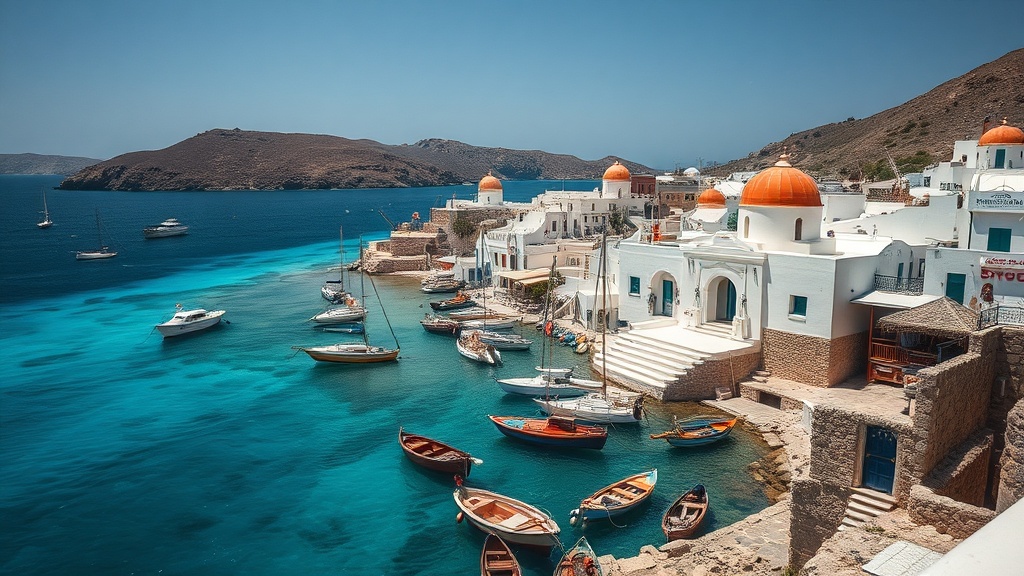
The Logistics of Island Hopping in the Cyclades

The Mathematics of Ferry Routes and Sea Conditions
In the Aegean Sea, a single storm can delay a ferry by twelve hours or cancel it entirely. While travelers often focus on the aesthetics of whitewashed walls, the actual success of a Greek island itinerary depends on understanding the complex ferry network. Unlike flight paths, sea routes are subject to wind velocity, wave height, and vessel capacity. If you're planning a trip through the Cyclades, you're not just booking a seat; you're betting on weather patterns and maritime logistics.
The Cyclades consist of dozens of islands, but they aren't all equal in terms of accessibility. Some islands serve as hubs, like Paros or Naxos, which receive frequent connections from both high-speed catamarans and slower, larger conventional ferries. Others are more isolated, requiring a multi-leg journey that increases the risk of a single point of failure in your schedule. When we look at the data, the most common mistake isn't choosing the wrong island—it's choosing the wrong method of transport between them.
High-speed vessels (catamarans) get you there faster, but they are more sensitive to the Meltemi winds. These strong, dry north winds blow through the Aegean in the summer and can make even a fast boat quite uncomfortable. If the wind hits a certain threshold, the ferry companies will swap the high-speed vessel for a larger, slower, more stable boat—or cancel the run altogether. This is why a rigid itinerary is often a recipe for frustration.
Is it better to take a ferry or a flight between Greek islands?
For most travelers, the choice between a flight and a ferry isn't actually a choice at all because you can't fly between the islands themselves. You fly to a major hub—Athens, Mykonos, or Santorini—and then use the sea to move. The real question is: do you fly from the mainland to an island, or do you take the ferry from Athens?
- The Flight Option: Flying from Athens to Santorini or Mykonos saves time (about 45 minutes in the air versus 5-8 hours on a ferry). It's also more predictable regarding weather, though wind can still ground small planes.
- The Ferry Option: Ferries are the backbone of the Aegean. They are significantly cheaper than regional flights and allow you to see the coastline. However, you must account for the "sea sickness factor." Even on large ships, the constant motion is a variable you can't control.
If you check the Greek Islands Ferry Schedules, you'll see that routes are categorized by speed and vessel type. A slow ferry might take six hours to reach Naxos from Athens, while a high-speed boat might do it in three. The slower boats are often more reliable in heavy seas, providing a more stable—if much longer—trip.
What is the best way to order ferry tickets in advance?
The digital landscape for Greek ferry booking is fragmented. You'll find several major players, but the availability of seats on popular routes during July and August can vanish weeks before the actual departure date. It's not just about the ticket; it's about the cargo. If you're renting a car or a scooter on an island, you'll need to ensure your ferry booking includes space for your vehicle. A car on a high-speed catamaran is a different logistical requirement than a car on a large, conventional ferry.
| Vessel Type | Speed | Stability | Best For |
|---|---|---|---|
| High-Speed Catamaran | Fast | Lower (Sensitive to wind) | Short distances, solo travelers |
| Conventional Ferry | Moderate | High (More stable) | Families, travelers with vehicles |
| Small Local Boat | Slow | Variable | Remote, smaller islands |
When booking, don't just look at the arrival time. Look at the vessel type. If the weather forecast predicts high winds, a sea-level flight or a slow boat is a safer bet than a high-speed catamaran. Many travelers rely on Ferryhopper to track real-time movements and see which companies are operating specific routes, which provides much more clarity than a static schedule.
How much should I budget for island-to-island travel?
Budgeting for the Cyclades requires a tiered approach. A short hop between nearby islands like Paros and Antiparos might cost under €20, while a long trek from Santorini to Ikaria can easily exceed €80. You must also account for the "hidden costs" of the sea. This includes the cost of luggage storage at the port if you arrive hours before your next connection, or the price of a taxi from the port to your hotel (ports are often located several kilometers away from the main towns).
If you are traveling with a vehicle, the price jumps significantly. A car on a ferry can double your transit cost. If you're moving between islands frequently, it might be more economical to rent a car on one island, use it for a week, and then return it before taking a ferry to the next destination, rather than paying to transport the vehicle across the Aegean. This reduces the logistical weight and the cost of the ticket.
Can I travel the Cyclades without a car?
It is possible, but it requires a different level of planning. On larger islands like Naxos or Crete (though Crete is in the much larger Cretan group), a car or scooter is almost mandatory to reach the more remote beaches and mountain villages. On smaller islands like Delos or Serifos, you can rely on local buses or even walking, provided you stay near the port or the main town. However, the local bus system is often infrequent and lacks the precision of mainland European transit. If a bus is scheduled for 10:15 AM, don't expect it to be there at 10:15 AM; it might arrive at 10:40 AM.
For those who choose to rely on public transit, the rule is simple: stay central. If you book an Airbnb in a remote valley on a small island, you'll find yourself paying for expensive private taxi transfers every time you want to see the sea. The most efficient way to navigate the islands is to treat each one as a distinct unit with its own internal transport-based constraints. Don't assume the transit-rich environment of Mykonos extends to the smaller, more rugged islands in the chain.