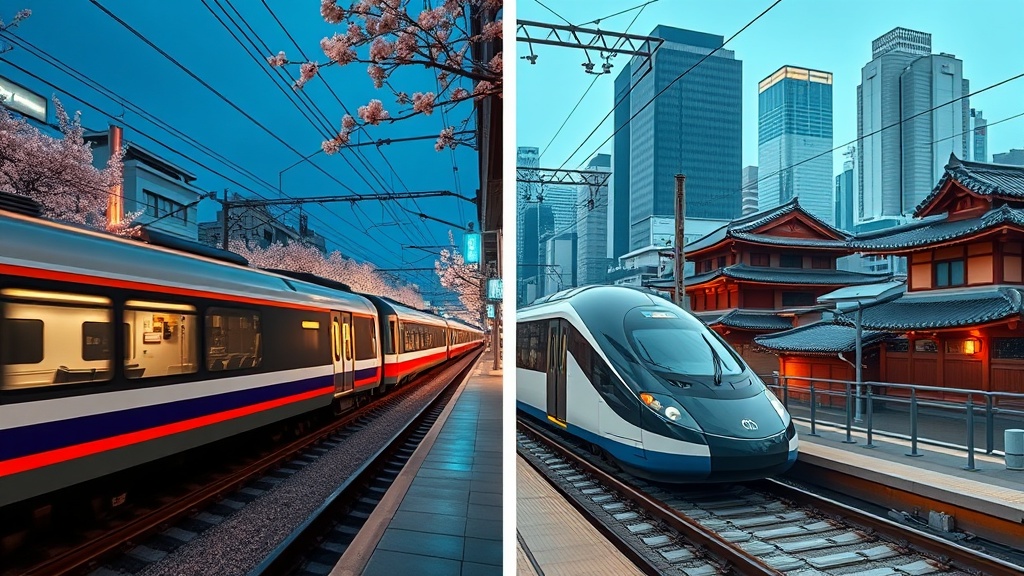
Japan vs. South Korea 2026: Ranked Across 8 Criteria

Spoiler: Japan wins overall for most first-time East Asia trips in 2026. South Korea is still the better value and better nightlife pick.
Most "Japan vs Korea" guides punt with "you can’t go wrong." That’s not useful when you’re about to spend real money.
I scored both countries across 8 criteria, weighted for a 10-14 day first or second trip.
The Verdict Up Front
- Best overall (2026): Japan
- Best for budget travelers: South Korea
- Best for first-timers: Japan
- Best for nightlife: South Korea
- Best for deep cultural travel: Japan
- Best for spontaneous, lower-planning trips: South Korea
Methodology (Transparent, Weighted, Repeatable)
I used an 8-criterion framework on a 10-point scale.
- Cost (20%)
- Transit & intercity efficiency (15%)
- Food scene depth and consistency (15%)
- Language barrier for English-speaking travelers (10%)
- Crowds/overtourism pressure (10%)
- Cultural accessibility (15%)
- Nightlife quality and variety (10%)
- Natural beauty access (5%)
Assumptions:
- USD-based traveler
- 10-14 day itinerary
- Major city + one secondary city (Tokyo/Kyoto vs Seoul/Busan)
- Spring/summer 2026 planning window
Exchange rates used for conversions:
- 1 USD = 156.05 JPY (FRED DEXJPUS, 2026-02-27)
- 1 USD = 1,439.82 KRW (FRED DEXKOUS, 2026-02-27)
Head-to-Head Scorecard
| Category | Japan | South Korea | Winner |
|---|---|---|---|
| Cost | 6.9 | 8.5 | South Korea |
| Transit | 9.6 | 8.1 | Japan |
| Food Scene | 9.7 | 8.5 | Japan |
| Language Barrier | 6.5 | 7.0 | South Korea |
| Crowds | 6.2 | 7.7 | South Korea |
| Cultural Accessibility | 9.4 | 7.8 | Japan |
| Nightlife | 8.0 | 9.2 | South Korea |
| Natural Beauty | 9.2 | 8.1 | Japan |
| Weighted Total | 8.2/10 | 8.1/10 | Japan |
Here’s the thing: this is close. If cost and nightlife are your top two priorities, Korea will likely feel like the better trip.
Cost Reality Check (Where Korea Wins)
The data says South Korea is generally cheaper for a similar trip style.
City price benchmarks (Numbeo, Mar 2026)
| Metric | Tokyo | Kyoto | Seoul | Busan |
|---|---|---|---|---|
| Inexpensive meal | ¥1,200 (~$7.69) | ¥1,750 (~$11.21) | ₩13,000 (~$9.03) | ₩10,000 (~$6.95) |
| Mid-range meal for 2 | ¥6,550 (~$41.97) | ¥5,000 (~$32.04) | ₩90,000 (~$62.51) | ₩65,000 (~$45.14) |
| One-way local transit | ¥215 (~$1.38) | ¥230 (~$1.47) | ₩1,550 (~$1.08) | ₩1,500 (~$1.04) |
| Monthly transit pass | ¥11,000 (~$70.49) | ¥12,850 (~$82.35) | ₩65,000 (~$45.14) | ₩80,000 (~$55.56) |
Daily trip budgets (Budget Your Trip snapshot data)
- Tokyo: ~$184/day
- Kyoto: ~$118/day
- Seoul: ~$124/day
- Busan: ~$104/day
A simple 12-day blended estimate:
- Japan (Tokyo+Kyoto blend): about $1,812/person
- South Korea (Seoul+Busan blend): about $1,368/person
That is roughly a $440+ per-person difference before splurges.
Transit & Trip Friction
Japan still has the strongest intercity rail experience in Asia for first-timers doing multi-city itineraries.
- Japan Rail Pass (official): 7-day ordinary pass is ¥50,000 (~$320)
- KORAIL Pass (KTO/VisitKorea fare table): flexible 2-day adult pass ₩121,000 (~$84), 3-day consecutive ₩138,000 (~$96)
Korea is cheaper on pass pricing. Japan is stronger on route density, schedule intuitiveness for classic tourist circuits, and long-distance convenience between major anchors.
My scoring split reflects that trade-off:
- Japan wins for first-time route execution.
- Korea wins if you want lower-cost intercity movement.
Crowds: Japan’s Overtourism Pressure Is Real
- JNTO reports 42,683,600 international visitors in 2025 (record year), with 3,617,700 in Dec 2025 alone.
- Korea’s tourism sector also hit a record rebound in 2025, but at a lower absolute inbound level: 18.5M reached by Dec 23, with 18.7M projected for full year (MCST reporting, quoted by Korea Times/Yonhap).
Translated for travelers: Japan has more crowd pressure in top corridors (Tokyo/Kyoto/Osaka hotspots) than Korea’s equivalent routes.
Category Winners (Quick Read)
Cost
Winner: South Korea
Lower transport costs and generally lower all-in daily burn make Korea the value play.
Transit
Winner: Japan
Japan’s rail ecosystem is still the benchmark for seamless first-time multi-city travel.
Food Scene
Winner: Japan
Both are elite. Japan gets the edge for breadth, regional variation, and consistency from convenience-store floor to omakase ceiling.
Language Barrier
Winner: South Korea
Neither is frictionless for monolingual English travelers, but Korea is currently the easier adjustment for many first-time visitors in core urban corridors.
Crowds
Winner: South Korea
Japan’s demand surge is great for tourism revenue, not always great for your personal space in peak zones.
Cultural Accessibility
Winner: Japan
Japan’s density of high-access cultural experiences is unmatched for a 10-14 day first itinerary.
Nightlife
Winner: South Korea
Seoul is the stronger late-night city right now on energy, price-to-fun ratio, and neighborhood variety.
Natural Beauty
Winner: Japan
Japan offers stronger range in one trip framework (mountains, coast, onsen regions, and seasonal contrasts).
Final Recommendation by Traveler Type
- First East Asia trip: Japan
- Value-first trip under tighter budget: South Korea
- Food-led itinerary: Japan
- Nightlife-forward trip with later nights: South Korea
- Culture + nature in one itinerary: Japan
- Short-notice, lower-planning trip: South Korea
What I’d Recommend (If You Want One Clear Pick)
If you can afford either and this is your first trip to the region, book Japan.
If you’re choosing based on value proposition and nightlife, book South Korea.
Look, this is not a vibes call. It’s a trade-off call. Japan gives you slightly higher overall trip depth; Korea gives you better cost efficiency and spontaneity.
If you tell me your budget and trip length, I can map this framework to a specific itinerary in 5 minutes.
This post contains affiliate links. If you book through these links, I earn a small commission at no extra cost to you. Rankings are based on independent research and are not influenced by affiliate relationships.
Sources
- JNTO monthly inbound release (Jan 21, 2026): https://www.jnto.go.jp/news/press/20260121_monthly.html
- JNTO tourism statistics portal: https://statistics.jnto.go.jp/en/graph/
- FRED DEXJPUS (JPY per USD): https://fred.stlouisfed.org/series/DEXJPUS
- FRED DEXKOUS (KRW per USD): https://fred.stlouisfed.org/series/DEXKOUS
- Numbeo Tokyo: https://www.numbeo.com/cost-of-living/in/Tokyo
- Numbeo Kyoto: https://www.numbeo.com/cost-of-living/in/Kyoto
- Numbeo Seoul: https://www.numbeo.com/cost-of-living/in/Seoul
- Numbeo Busan: https://www.numbeo.com/cost-of-living/in/Busan
- Japan Rail Pass official pricing: https://japanrailpass.net/en/purchase/price/
- KORAIL Pass (VisitKorea/KTO): https://english1.visitkorea.or.kr/enu/TRP/TP_ENG_8_2.jsp
- Korea inbound tourism milestone coverage (MCST/KTO statements): https://www.koreatimes.co.kr/lifestyle/travel-food/20251223/visitors-to-korea-to-hit-record-187-million-this-year-outpacing-pre-pandemic-high